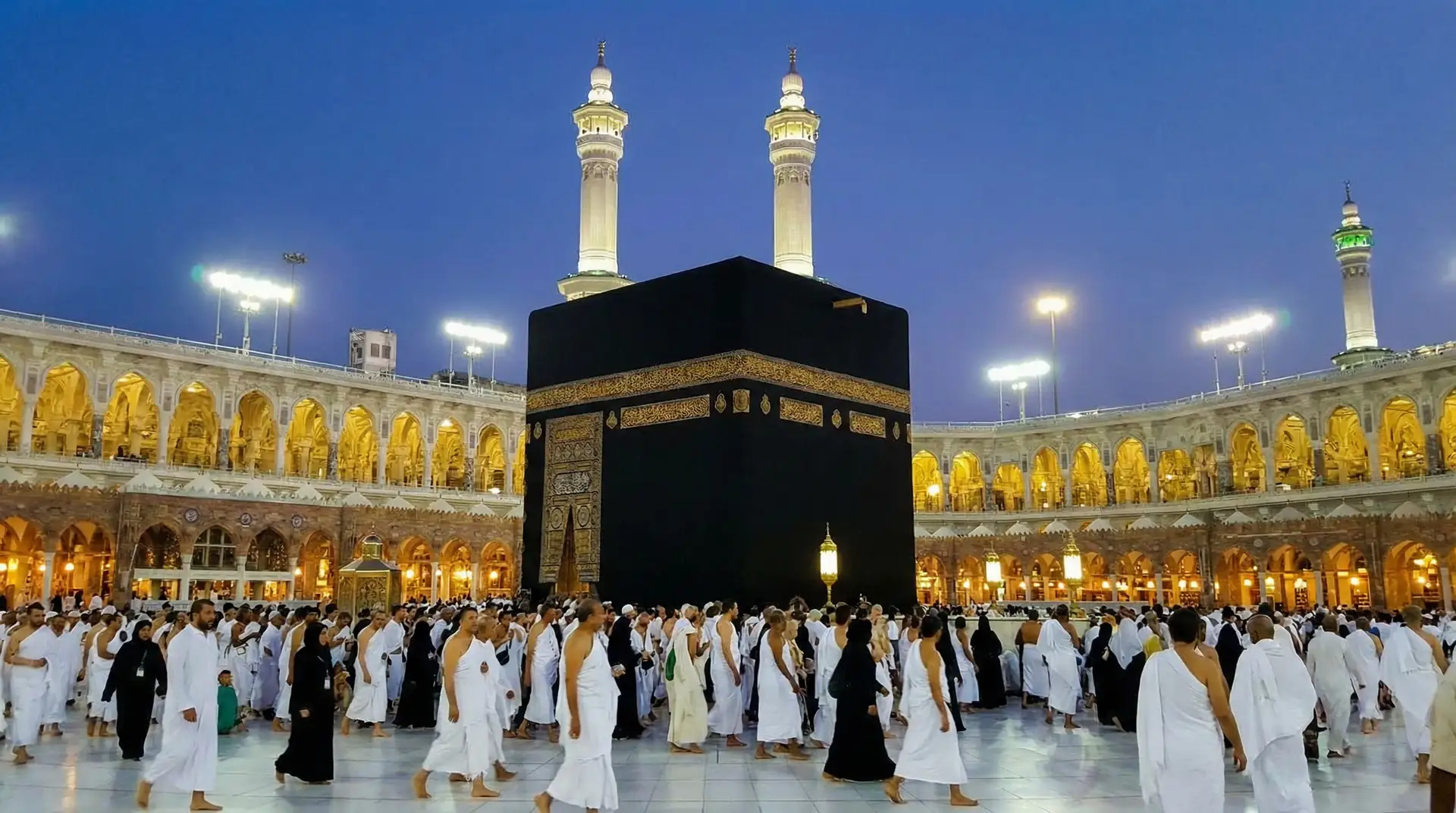
Umrah Visa from Dubai: Complete Application Guide 2026
Do I need a special Umrah visa from Dubai?
No. In 2026 you do not need a separate Umrah visa. The Saudi tourist eVisa is granted for tourism or for performing Umrah (official Terms & Conditions §8.7), and UAE residents of any nationality can obtain it via the residence route. The eVisa is your entry visa; you must then book your Umrah permit through the official Nusuk platform. Because a confirmed Nusuk accommodation booking is now required before the eVisa is issued for Umrah ("No Booking, No Visa"), you arrange the Nusuk booking first. Dedicated Umrah visas through authorised agents and all-inclusive packages remain available if you prefer. All routes apply for Umrah outside the Hajj season.
Key Takeaway
- No. In 2026 you do not need a separate Umrah visa. The Saudi tourist eVisa is granted for tourism or for performing Umra...
- Umrah on tourist eVisa: Permitted (§8.7)
- eVisa Processing: 1 min – 3 business days
- Nusuk Permit: Mandatory
- Tourist eVisa (govt fee): SAR 300 + ~180 insurance
Umrah is one of the most common reasons UAE residents travel to Saudi Arabia, with hundreds of thousands departing from Dubai every year. The single most important thing to understand in 2026 is this: you do not need a separate "Umrah visa" to perform Umrah. Saudi Arabia's tourist eVisa is granted for tourism or for performing Umrah under the official Terms & Conditions (clause 8.7), so the eVisa most UAE residents already qualify for is enough to enter and perform Umrah outside the Hajj season. What you still must obtain — separately from the visa — is an Umrah permit through the official Nusuk platform.
This guide covers everything UAE residents need for Umrah from Dubai in 2026: why the tourist eVisa (including the residence-route eVisa open to any nationality) already permits Umrah, the mandatory Nusuk permit and the current "No Booking, No Visa" rule, a full document checklist, costs, the Hajj-season window when Makkah is closed to visit-visa holders, how Umrah differs from Hajj, common mistakes to avoid, and how OraVisa can help you prepare the trip.
Do You Need an Umrah Visa? Routes for UAE Residents
The key thing to get right is the difference between a visa and a permit. The visa is your permission to enter Saudi Arabia; the Nusuk permit is your permission to perform Umrah. In 2026 the Saudi tourist eVisa already covers Umrah as a granted purpose, so most UAE residents do not need a separate Umrah visa — they need the eVisa (to enter) plus the Nusuk permit (to perform Umrah). A dedicated Umrah visa through an authorised agent, and fully managed packages, remain available for those who prefer them.
Routes to Umrah from Dubai — Comparison
| Route | How It Works | Best For | Notes |
|---|---|---|---|
| Tourist eVisa + Nusuk permit | Apply for the Saudi tourist eVisa online — its granted purpose already covers Umrah (§8.7) — then book your Umrah permit and accommodation through Nusuk | Most UAE residents; combining Umrah with tourism | eVisa = entry; Nusuk permit = Umrah. Open to any nationality via the residence route. |
| Dedicated Umrah visa (via authorised agent) | An authorised agent registers and processes an Umrah visa through Nusuk on your behalf | Pilgrimage-focused travellers who want an agent to handle everything | Still available; not required if you hold or obtain a tourist eVisa |
| Umrah package | An agent bundles the visa, Nusuk booking, hotel and transport as one package | First-time pilgrims, families, groups | All-inclusive; most convenient, least flexible |
Tourist eVisa + Nusuk permit
- How It Works
- Apply for the Saudi tourist eVisa online — its granted purpose already covers Umrah (§8.7) — then book your Umrah permit and accommodation through Nusuk
- Best For
- Most UAE residents; combining Umrah with tourism
- Notes
- eVisa = entry; Nusuk permit = Umrah. Open to any nationality via the residence route.
Dedicated Umrah visa (via authorised agent)
- How It Works
- An authorised agent registers and processes an Umrah visa through Nusuk on your behalf
- Best For
- Pilgrimage-focused travellers who want an agent to handle everything
- Notes
- Still available; not required if you hold or obtain a tourist eVisa
Umrah package
- How It Works
- An agent bundles the visa, Nusuk booking, hotel and transport as one package
- Best For
- First-time pilgrims, families, groups
- Notes
- All-inclusive; most convenient, least flexible
Under the official eVisa Terms & Conditions (clause 8.7): "An eVisa is granted solely for tourist purposes or for the purpose of performing a umrah." All entry visa types (tourist eVisa, visit, transit) can be used for Umrah outside the Hajj season — a separate Umrah visa is not required. The Nusuk permit, however, is always required.
Visa vs Permit — the Key Distinction
- The eVisa is your ENTRY visa — the tourist eVisa already permits Umrah (§8.7), so you do not need a separate Umrah visa.
- The Nusuk permit is your UMRAH permit — mandatory and separate from the visa. No permit, no Umrah.
- UAE residents of any nationality can obtain the tourist eVisa via the residence route (valid UAE residence permit ≥3 months, passport ≥6 months, applicant 18+).
- All Umrah routes apply outside the Hajj season, when Makkah is closed to visit-visa holders (see the season section below).
Umrah Requirements from Dubai
The document requirements for Umrah from Dubai are straightforward but strict. Prepare everything before you apply, and note the current "No Booking, No Visa" rule: for Umrah, the eVisa is now linked to a confirmed Nusuk accommodation booking, so you arrange the Nusuk booking first and apply for the eVisa second.
Core Documents Required
- Valid passport — minimum 6 months validity from the date of travel, with at least two blank pages.
- UAE residence permit (for the residence-route eVisa) — valid, with at least 3 months remaining. This is what lets UAE residents of any nationality obtain the tourist eVisa regardless of passport.
- Emirates ID — valid copy for UAE-based applicants.
- Confirmed Nusuk accommodation booking — required before the Umrah eVisa is issued ("No Booking, No Visa"); you receive a Nusuk Booking Reference Number.
- Meningococcal ACWY vaccination certificate — mandatory for Umrah pilgrims, administered at least 10 days before travel. Available at DHA clinics in Dubai.
- Passport-size photograph — recent, white background, meeting Saudi/Nusuk specifications.
- Return flight ticket — confirmed booking showing entry and exit dates.
Women Travelling for Umrah — No Mahram Required
Women can perform Umrah without a mahram (male guardian). Saudi Arabia's Ministry of Hajj and Umrah removed the mahram requirement — women of any age may perform Umrah, travelling individually or as part of an organised group. The earlier rule that required younger women to be accompanied by a mahram no longer applies. This brings the Umrah process into line with the tourist eVisa, which any eligible woman can obtain in her own right.
Age
The tourist eVisa applicant must be 18 or older; minors are included on a parent or guardian's application and must be accompanied. There is no upper age limit for Umrah, though elderly pilgrims are advised to carry a medical fitness certificate.
Umrah Costs from Dubai in 2026
Because most UAE residents perform Umrah on the tourist eVisa, the core government cost is the eVisa fee itself — the rest depends on your accommodation, transport and whether you use an agent. Below is a breakdown by route.
Umrah Cost Components — Dubai to Saudi Arabia (2026)
| Cost Component | Tourist eVisa + Nusuk | Dedicated Umrah Visa (agent) | Umrah Package |
|---|---|---|---|
| Government eVisa fee | SAR 300 (~AED 295) + mandatory insurance ~SAR 180 (~AED 177) ≈ SAR 480 | Included in agent fee | Included in package |
| Nusuk permit | Issued via the Nusuk app | Handled by the agent via Nusuk | Handled within the package |
| Accommodation (Nusuk booking) | Booked via Nusuk (varies by hotel and season) | Arranged by the agent | Included in package |
| Meningitis ACWY vaccine | Your cost (DHA clinic) | Your cost (DHA clinic) | Your cost (DHA clinic) |
Government eVisa fee
- Tourist eVisa + Nusuk
- SAR 300 (~AED 295) + mandatory insurance ~SAR 180 (~AED 177) ≈ SAR 480
- Dedicated Umrah Visa (agent)
- Included in agent fee
- Umrah Package
- Included in package
Nusuk permit
- Tourist eVisa + Nusuk
- Issued via the Nusuk app
- Dedicated Umrah Visa (agent)
- Handled by the agent via Nusuk
- Umrah Package
- Handled within the package
Accommodation (Nusuk booking)
- Tourist eVisa + Nusuk
- Booked via Nusuk (varies by hotel and season)
- Dedicated Umrah Visa (agent)
- Arranged by the agent
- Umrah Package
- Included in package
Meningitis ACWY vaccine
- Tourist eVisa + Nusuk
- Your cost (DHA clinic)
- Dedicated Umrah Visa (agent)
- Your cost (DHA clinic)
- Umrah Package
- Your cost (DHA clinic)
The SAR 300 eVisa fee plus mandatory insurance (~SAR 180) — roughly SAR 480 (~AED 470) — is a Saudi government charge and is stated here for information; figures move with the exchange rate and are set by the Saudi authorities. Accommodation and any agent charges vary by season; Hajj-adjacent and Ramadan periods cost more. All figures exclude flights.
Cost-Saving Tips
- The tourist eVisa is valid for one year with multiple entries (90-day stay per visit) — if you plan more than one Saudi trip this year, it can cover repeat Umrah and tourism on a single eVisa.
- Book off-peak (the months before Ramadan) for the lowest accommodation rates; avoid the Hajj-season window entirely (see below).
- Get the meningitis ACWY vaccine at a DHA government clinic rather than a private hospital.
- You can book your Nusuk accommodation and issue the Umrah permit yourself — an agent is optional if you hold a tourist eVisa.
How to Perform Umrah from Dubai — Step by Step
For most UAE residents the route is: confirm eVisa eligibility, make your Nusuk booking, apply for the eVisa, then issue your Umrah permit. Here is the process in order.
- 1Confirm your eVisa eligibility — UAE residents of any nationality qualify via the residence route (valid residence permit ≥3 months, passport ≥6 months, applicant 18+). Many nationalities also qualify by passport, or by holding a Schengen/US/UK visa or US/EU/UK permanent residence.
- 2Make your Nusuk booking first — because of the "No Booking, No Visa" rule, book your Umrah accommodation (and transport where required) through the Nusuk platform before applying; you receive a Nusuk Booking Reference Number that links to the visa.
- 3Apply for the Saudi tourist eVisa online — its granted purpose covers Umrah (§8.7). Official processing is 1 minute to 3 business days.
- 4Issue your Umrah permit on the Nusuk app — this is mandatory and separate from the visa. Register as a visitor in the Nusuk app, issue your Umrah permit, and reserve your mosque and Rawdah appointments.
- 5Prepare your documents and vaccine — passport, UAE residence permit, meningococcal ACWY certificate and photo. No mahram documentation is required for women.
The tourist eVisa is typically issued within 1 minute to 3 business days (official ksavisa.sa). Your Umrah permit is issued through the Nusuk app once your booking is confirmed. Keep both your eVisa and your Nusuk permit accessible on your phone — the Umrah permit is verified at the Haram checkpoints through the Nusuk and Tawakkalna apps. Prefer to delegate? An authorised agent can process a dedicated Umrah visa and handle the Nusuk booking for you.
Application Tips
- Arrange your Nusuk accommodation booking before applying for the eVisa — the Umrah eVisa is now linked to a confirmed Nusuk booking.
- The eVisa gets you in; the Nusuk permit lets you perform Umrah. You need both.
- Ensure your meningitis ACWY vaccine was administered at least 10 days before entry — Saudi immigration checks this.
- Avoid travelling during the Hajj-season window, when Makkah is closed to visit-visa holders (see the season section).
Umrah vs Hajj: Keep Them Separate
Umrah and Hajj are both pilgrimages to Makkah, but they are entirely different from a visa standpoint, and it is important not to confuse them. Umrah can be performed year-round (outside the Hajj-season window) on a tourist eVisa plus a Nusuk permit. Hajj is a separate, quota-based process that requires a dedicated Hajj visa issued only for the Hajj period — you cannot convert a tourist eVisa or an Umrah permit into Hajj.
Umrah vs Hajj — Side-by-Side
| Factor | Umrah | Hajj |
|---|---|---|
| Timing | Year-round, except the Hajj-season window | Fixed dates: 8th–13th Dhul Hijjah only |
| Visa | No separate visa needed — tourist eVisa permits Umrah (§8.7); or a dedicated Umrah visa via agent | Dedicated Hajj visa only, allocated by quota |
| Permit | Nusuk Umrah permit (mandatory) | Nusuk Hajj permit within the quota system |
| Quota | No quota — open to all eligible visitors | Strict country-based quota; demand exceeds supply |
| Application channel | Tourist eVisa + Nusuk permit; or authorised agent | Official Nusuk/Ministry Hajj quota channel via licensed Hajj operators |
| Conversion | A tourist eVisa cannot be converted into a Hajj visa | Hajj requires its own dedicated visa |
Timing
- Umrah
- Year-round, except the Hajj-season window
- Hajj
- Fixed dates: 8th–13th Dhul Hijjah only
Visa
- Umrah
- No separate visa needed — tourist eVisa permits Umrah (§8.7); or a dedicated Umrah visa via agent
- Hajj
- Dedicated Hajj visa only, allocated by quota
Permit
- Umrah
- Nusuk Umrah permit (mandatory)
- Hajj
- Nusuk Hajj permit within the quota system
Quota
- Umrah
- No quota — open to all eligible visitors
- Hajj
- Strict country-based quota; demand exceeds supply
Application channel
- Umrah
- Tourist eVisa + Nusuk permit; or authorised agent
- Hajj
- Official Nusuk/Ministry Hajj quota channel via licensed Hajj operators
Conversion
- Umrah
- A tourist eVisa cannot be converted into a Hajj visa
- Hajj
- Hajj requires its own dedicated visa
Hajj is a distinct, quota-allocated process handled through the official Hajj channel — it is outside OraVisa's tourist-visa scope. This guide covers Umrah logistics only.
The Hajj-Season Window — When You Cannot Perform Umrah
⚠️ This is the single most important point for timing your trip. Each year, for a period around Hajj, Makkah is closed to tourist-eVisa and visit-visa holders, and Umrah permits are suspended — only pilgrims with a valid Hajj permit may stay in Makkah during that window. If you plan Umrah around May–June, you must check the current dates first.
Hajj-Season Umrah Suspension — Verified Dates
| Year | Umrah/visit-visa Makkah restriction | Normal Umrah resumed |
|---|---|---|
| 2025 | Makkah entry restricted for visit-visa holders; window ran approximately 29 April – 11 June 2025 | From mid-June 2025 |
| 2026 | Nusuk Umrah permits suspended from 18 April 2026; Makkah closed to visit-visa holders during the Hajj window | 31 May 2026 (Makkah entry and Nusuk Umrah permits available again from 1 June 2026) |
2025
- Umrah/visit-visa Makkah restriction
- Makkah entry restricted for visit-visa holders; window ran approximately 29 April – 11 June 2025
- Normal Umrah resumed
- From mid-June 2025
2026
- Umrah/visit-visa Makkah restriction
- Nusuk Umrah permits suspended from 18 April 2026; Makkah closed to visit-visa holders during the Hajj window
- Normal Umrah resumed
- 31 May 2026 (Makkah entry and Nusuk Umrah permits available again from 1 June 2026)
Dates from the Ministry of Hajj and Umrah season calendar. These shift each year with the Islamic calendar — always verify the current window at ksavisa.sa / Nusuk before booking Umrah travel around this period.
Outside that window, Umrah can be performed year-round. For UAE residents, the off-peak winter months (roughly October to February, before Ramadan) offer the most pleasant weather, lower accommodation costs and manageable crowds. Flights from Dubai to Jeddah are under three hours, making even a long-weekend Umrah feasible. Ramadan carries the highest spiritual significance but requires booking well in advance because accommodation near the Haram is in extreme demand.
Common Umrah Mistakes from Dubai
Most Umrah disruptions from Dubai come from avoidable mistakes. Saudi authorities enforce documentation and permit rules strictly, and the visa/permit distinction trips up first-time pilgrims. Here are the most common errors and how to avoid them.
- 1Assuming the eVisa is enough on its own — it is not. The tourist eVisa lets you enter; you still need a Nusuk Umrah permit to perform Umrah. No permit, no Umrah.
- 2Applying for the eVisa before making your Nusuk booking — under the "No Booking, No Visa" rule the Umrah eVisa is linked to a confirmed Nusuk accommodation booking, so arrange the Nusuk booking first.
- 3Travelling during the Hajj-season window — Makkah is closed to visit-visa holders for a period around Hajj (in 2026, roughly 18 April to 31 May). Check the current dates before booking.
- 4Expired passport or short residence permit — your passport needs at least 6 months validity, and the residence-route eVisa needs a UAE residence permit valid for at least 3 more months.
- 5No meningitis vaccination certificate — the meningococcal ACWY vaccine is mandatory and must be administered at least 10 days before entry. Pilgrims without proof are denied entry.
- 6Booking non-refundable flights before your eVisa is approved — allow for processing and book refundable options until your visa is confirmed.
- 7Using an unlicensed agent — if you choose the agent route, verify the agent is registered with the Saudi Ministry of Hajj and Umrah before paying; only licensed agents can register pilgrims on Nusuk.
Pre-Travel Checklist
- Passport valid 6+ months with 2 blank pages; UAE residence permit valid 3+ months
- Nusuk accommodation booking confirmed (Booking Reference Number) before applying for the eVisa
- Tourist eVisa issued; Nusuk Umrah permit issued and accessible offline
- Meningitis ACWY vaccine taken 10+ days before travel
- Travel dates outside the Hajj-season window (verify current dates)
First-Time Umrah from Dubai: Practical Tips
If this is your first Umrah from Dubai, planning the logistics makes the trip far smoother. These are practical, non-ritual tips for organising the travel side.
- Choose your entry airport by itinerary: Jeddah (King Abdulaziz International, about 2.5 hours from Dubai) is the usual gateway for a Makkah-first trip; Madinah (Prince Mohammad bin Abdulaziz International, about 2 hours) suits a Madinah-first itinerary. Emirates, flydubai, Air Arabia and Saudia all fly direct.
- Book your accommodation through Nusuk as early as you can — remember the "No Booking, No Visa" rule means the eVisa is linked to a confirmed Nusuk booking. Hotels closer to the Haram cost more but greatly reduce walking and strain.
- Reserve your Rawdah visit permit at Masjid an-Nabawi in Madinah through the Nusuk app as soon as your booking is confirmed — slots fill up quickly.
- Download the Nusuk app before you travel — it holds your Umrah permit and provides prayer times, mosque-entry appointments and navigation inside the holy mosques.
- Carry printed copies of your eVisa, Nusuk permit, hotel voucher and meningitis (ACWY) vaccination certificate — digital copies alone may not be accepted at every checkpoint.
- Pack light, comfortable footwear that is easy to remove for prayer, and allow buffer time in your schedule during peak periods when crowds are largest.
How OraVisa Helps with Your Umrah Trip
OraVisa helps UAE residents prepare the travel side of Umrah — confirming your tourist eVisa eligibility (including the residence route open to any nationality), preparing your documents, and guiding you through the Nusuk booking and permit so the visa and permit steps line up correctly.
- eVisa eligibility check — we confirm the right route for your nationality and UAE residence, so you apply once, correctly.
- Document preparation — we review your passport, residence permit, photo and vaccination certificate before you apply to avoid rejections.
- Nusuk and permit guidance — we help you sequence the Nusuk accommodation booking and the Umrah permit around the "No Booking, No Visa" rule.
- Timing advice — we flag the Hajj-season window so you do not book travel into the period when Makkah is closed to visit-visa holders.
Planning Umrah from Dubai?
OraVisa helps UAE residents get the tourist eVisa and prepare the documents and Nusuk steps for Umrah — for any nationality, via the residence route. Start with a free consultation.
Get Free Umrah eVisa AssessmentFrequently Asked Questions
Do I need a special Umrah visa from the UAE?
No. The Saudi tourist eVisa is granted for tourism or for performing Umrah under the official Terms & Conditions (clause 8.7), so you do not need a separate Umrah visa. The eVisa is your entry visa; you must still obtain a Nusuk Umrah permit to perform Umrah, and a confirmed Nusuk accommodation booking is required before the eVisa is issued. A dedicated Umrah visa via an authorised agent remains available if you prefer.
How much does Umrah cost from the UAE in 2026?
On the tourist eVisa route, the core government cost is the eVisa fee — SAR 300 (~AED 295) plus mandatory insurance of about SAR 180, roughly SAR 480 (~AED 470), a Saudi government charge. Beyond that, your cost is accommodation (booked via Nusuk) and, optionally, an agent or package. The Umrah permit itself is issued through the Nusuk app. Costs rise in Ramadan and around the Hajj season.
How long does the Saudi eVisa take to process from Dubai?
Official processing for the Saudi tourist eVisa is 1 minute to 3 business days (ksavisa.sa). Because the Umrah eVisa is linked to a confirmed Nusuk booking, arrange your Nusuk accommodation booking first, then apply for the eVisa.
Can UAE residents arrange Umrah without a travel agent?
Yes. If you hold or obtain a Saudi tourist eVisa, you can make your Nusuk accommodation booking and issue your Umrah permit yourself on the Nusuk platform — no agent is required. A dedicated Umrah visa, if you prefer that route, is processed through an authorised agent registered with the Saudi Ministry of Hajj and Umrah.
How long is the visa valid for Umrah?
The Saudi tourist eVisa is valid for one year with multiple entries and a stay of up to 90 days per visit, and it permits Umrah (§8.7). A dedicated Umrah visa is typically valid for up to 90 days. Always confirm the current validity at ksavisa.sa, as terms can change.
Can women travel for Umrah from Dubai without a mahram?
Yes. Saudi Arabia's Ministry of Hajj and Umrah removed the mahram requirement — women of any age can perform Umrah without a mahram (male guardian), travelling individually or as part of an organised group. The previous rule requiring younger women to be accompanied by a mahram no longer applies.
What is the "No Booking, No Visa" rule for Umrah?
For Umrah, the Saudi eVisa is now linked to a confirmed Nusuk accommodation booking — you cannot obtain the visa without first making the booking and receiving a Nusuk Booking Reference Number. In practice this means you book your Umrah accommodation through Nusuk first, then apply for the eVisa.
Can I perform Umrah on a Saudi tourist eVisa during Hajj season?
No. Each year, for a window around Hajj, Makkah is closed to tourist-eVisa and visit-visa holders and Umrah permits are suspended — only Hajj-permit holders may stay in Makkah. In 2026 that window ran from about 18 April, with normal Umrah resuming on 31 May 2026. These dates shift yearly, so verify the current window at ksavisa.sa / Nusuk before booking.
What vaccinations are required for Umrah from the UAE?
The meningococcal ACWY vaccine is mandatory for Umrah pilgrims and must be administered at least 10 days before entering Saudi Arabia. It is available at DHA clinics in Dubai. Seasonal influenza vaccination is also recommended, particularly for elderly pilgrims and those with chronic conditions.
Need Expert Visa Assistance?
OraVisa handles everything from document preparation to submission; you attend in person only where the mission requires biometrics or an interview. Get a free consultation today.
Get Free ConsultationTools to Help You Prepare
All tools are free — no login required. View all tools →
Related Visa Guides
Latest Visa Updates
Written by
Ahmed Al Rashid
Senior Visa Consultant
Senior Visa Consultant at OraVisa with 12+ years of visa consultancy experience. Has guided thousands of UAE residents through successful visa applications for 100+ countries.
Expert reviewed by Ahmed Al Rashid
Senior Visa Consultant
Last updated: · 12+ years of visa consultancy experience
Last updated: