Thailand Mandates 21-Day Ebola Quarantine for Travellers from DR Congo and Uganda — Effective 27 May 2026
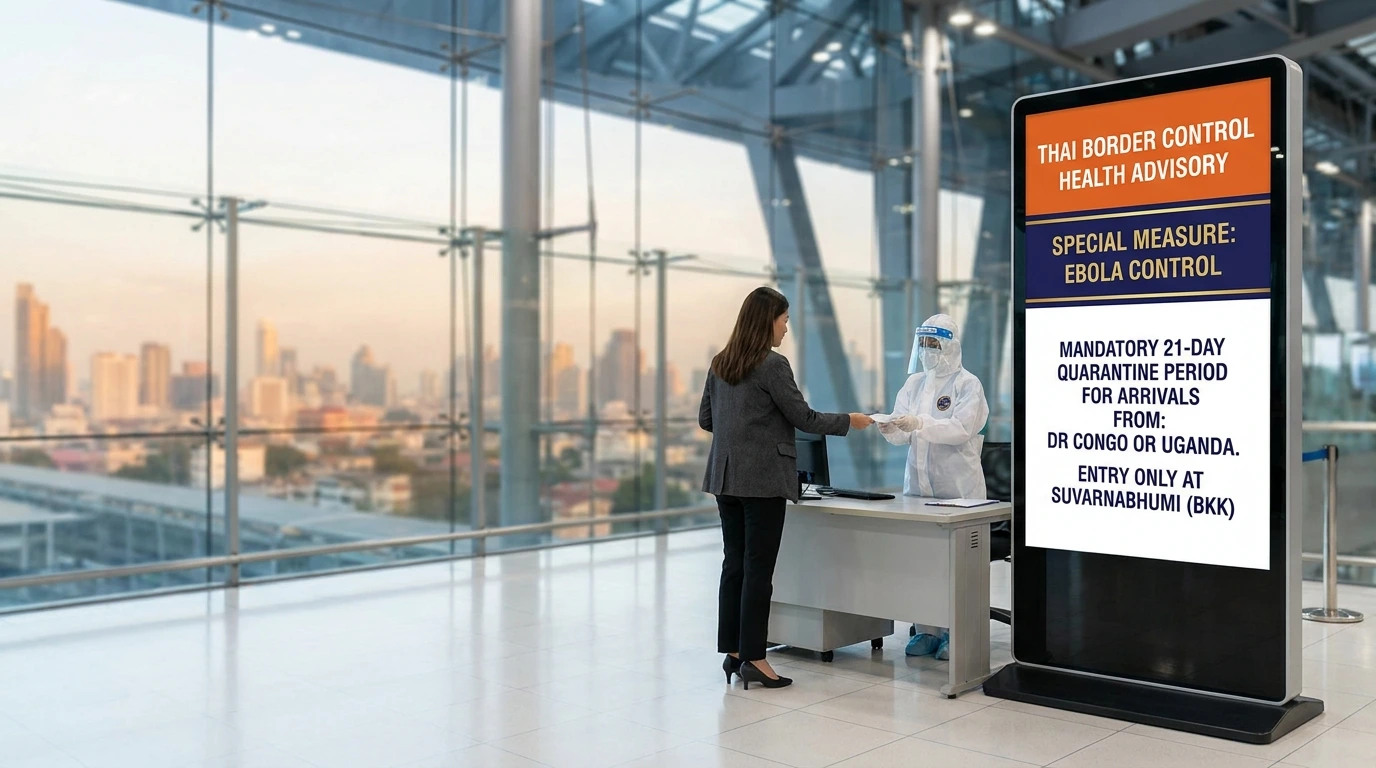
From 6:00 PM Bangkok time on 27 May 2026, Thailand mandates a 21-day quarantine for any traveller arriving from or transiting through the Democratic Republic of Congo or Uganda, with entry restricted to Suvarnabhumi Airport in Bangkok. Breaches carry jail terms and fines under Thailand's Communicable Diseases Act. OraVisa explains the impact on UAE residents, the outbreak context behind the policy, and what to do if your recent travel history triggers the new screening.
What Has Changed and When
On 27 May 2026, Thailand's National Communicable Disease Committee — chaired by the Public Health Ministry and operationalised by the Department of Disease Control (DDC) — approved tightened entry measures for travellers arriving from or transiting through the Democratic Republic of Congo and Uganda. Both countries have been declared "dangerous communicable disease zones" for Ebola virus disease, unlocking the strongest set of controls available under Thai law.
The new measures took effect at 6:00 PM Bangkok time on the same day. Under the previous regime, arrivals from at-risk countries were simply kept under observation. Under the new regime, every qualifying arrival is now placed under a 21-day quarantine or isolation — the maximum incubation window for Ebola — and routed through a single airport for centralised screening.
Key Facts at a Glance
- Effective: 6:00 PM Bangkok time, 27 May 2026.
- Authority: Thailand's National Communicable Disease Committee (3rd meeting of 2026) and the Department of Disease Control, under the Public Health Ministry.
- Countries in scope: Democratic Republic of Congo and Uganda — declared dangerous communicable disease zones.
- Trigger: Travel from, or transit through, either country at any point in the last 21 days.
- New regime: 21-day quarantine (asymptomatic) or 21-day isolation in a state hospital (symptomatic).
- Airport: Entry restricted to Suvarnabhumi Airport (BKK) only.
- Cases in Thailand: Zero confirmed Ebola cases as of the announcement.
The New Rules in Detail
The Department of Disease Control has been instructed to prepare quarantine facilities for arrivals from 6:00 PM on 27 May 2026. The table below contrasts the previous observation framework with the new mandatory regime.
Before vs After — Thailand Ebola Entry Controls
| Element | Before 27 May 2026 | From 27 May 2026 (6:00 PM) |
|---|---|---|
| Airport routing | Arrivals could land at any international Thai airport | Arrivals and transit travellers from DR Congo or Uganda must enter only via Suvarnabhumi Airport (BKK) |
| Screening regime | Voluntary self-monitoring and observation | Mandatory 21-day quarantine (asymptomatic) at designated facilities |
| Symptomatic travellers | Referral to local hospital on a case-by-case basis | Mandatory 21-day isolation at a state hospital designated by the Department of Disease Control |
| Duration of measure | n/a | 21 days from arrival — matches Ebola's maximum incubation period |
| Legal framework | Communicable Diseases Act 2015 | Same Act invoked, with full quarantine and isolation powers under Section 34 |
| Travel-history declaration | Standard arrival card | Truthful declaration required; misrepresentation is a separate offence |
Airport routing
- Before 27 May 2026
- Arrivals could land at any international Thai airport
- From 27 May 2026 (6:00 PM)
- Arrivals and transit travellers from DR Congo or Uganda must enter only via Suvarnabhumi Airport (BKK)
Screening regime
- Before 27 May 2026
- Voluntary self-monitoring and observation
- From 27 May 2026 (6:00 PM)
- Mandatory 21-day quarantine (asymptomatic) at designated facilities
Symptomatic travellers
- Before 27 May 2026
- Referral to local hospital on a case-by-case basis
- From 27 May 2026 (6:00 PM)
- Mandatory 21-day isolation at a state hospital designated by the Department of Disease Control
Duration of measure
- Before 27 May 2026
- n/a
- From 27 May 2026 (6:00 PM)
- 21 days from arrival — matches Ebola's maximum incubation period
Legal framework
- Before 27 May 2026
- Communicable Diseases Act 2015
- From 27 May 2026 (6:00 PM)
- Same Act invoked, with full quarantine and isolation powers under Section 34
Travel-history declaration
- Before 27 May 2026
- Standard arrival card
- From 27 May 2026 (6:00 PM)
- Truthful declaration required; misrepresentation is a separate offence
Dr Montien Kanasawat, Director-General of the Department of Disease Control, said after the committee meeting: "I ask all travellers to provide their travel history truthfully so that disease prevention and control can be carried out effectively. I also ask the public to have confidence in Thailand's surveillance system, which is fully prepared in terms of personnel, medical supplies and high-level laboratories."
Legal Penalties for Breach
Thai officials have warned that travellers who disobey disease control orders face criminal penalties under the Communicable Diseases Act BE 2558 (2015). The penalties scale sharply depending on which order is breached.
Penalties under the Communicable Diseases Act 2015
| Type of breach | Statutory basis | Penalty |
|---|---|---|
| Refusing an order to enter quarantine or isolation | Section 34(1) of the Act; penalty under Section 51 | Fine of up to 20,000 baht (approximately AED 2,200) |
| Leaving a quarantine or isolation facility without authorisation | Section 34(7) of the Act; penalty under Section 52 | Up to one year in prison, a fine of up to 100,000 baht (approximately AED 11,000), or both |
Refusing an order to enter quarantine or isolation
- Statutory basis
- Section 34(1) of the Act; penalty under Section 51
- Penalty
- Fine of up to 20,000 baht (approximately AED 2,200)
Leaving a quarantine or isolation facility without authorisation
- Statutory basis
- Section 34(7) of the Act; penalty under Section 52
- Penalty
- Up to one year in prison, a fine of up to 100,000 baht (approximately AED 11,000), or both
The penalty regime is unusually severe for a public-health screening exercise — a deliberate signal from Thai authorities that quarantine compliance is not negotiable.
What This Means for UAE Residents
For the vast majority of UAE residents, this change has no practical effect — Thailand's standard visa-free, visa-exemption and e-Visa channels remain open as before for travellers whose recent itinerary does not include DR Congo or Uganda. The new screening applies only by travel history, not by passport nationality.
UAE-Resident Impact by Travel-History Profile
| Traveller profile | Affected? | Practical implication |
|---|---|---|
| UAE resident with no DR Congo or Uganda travel in the last 21 days | No | Standard Thailand entry, visa-exempt or visa-required by nationality, unchanged. |
| UAE resident transiting Bangkok without recent DR Congo or Uganda travel | No | Normal transit experience at Suvarnabhumi or Don Mueang. |
| UAE resident who visited DR Congo or Uganda in the last 21 days (any reason) | Yes — directly | Must arrive at Suvarnabhumi only; subject to mandatory 21-day quarantine on arrival. |
| UAE-based aid worker, NGO staff, or business traveller on Central-Africa rotation | Yes | Reconsider Thailand routing during the active outbreak; quarantine cost and time are material. |
| UAE-based diplomatic, consular or accredited mission staff | Yes (no automatic carve-out) | Coordinate with the relevant Thai mission and Public Health Ministry in advance. |
| Saudi Arabian and other GCC nationals identified by Dr Anek Mungaomklang as already in Thailand | Already under measures | 53 travellers from 16 nationalities (including Saudi Arabian) are already under quarantine following arrivals from the affected zones. |
UAE resident with no DR Congo or Uganda travel in the last 21 days
- Affected?
- No
- Practical implication
- Standard Thailand entry, visa-exempt or visa-required by nationality, unchanged.
UAE resident transiting Bangkok without recent DR Congo or Uganda travel
- Affected?
- No
- Practical implication
- Normal transit experience at Suvarnabhumi or Don Mueang.
UAE resident who visited DR Congo or Uganda in the last 21 days (any reason)
- Affected?
- Yes — directly
- Practical implication
- Must arrive at Suvarnabhumi only; subject to mandatory 21-day quarantine on arrival.
UAE-based aid worker, NGO staff, or business traveller on Central-Africa rotation
- Affected?
- Yes
- Practical implication
- Reconsider Thailand routing during the active outbreak; quarantine cost and time are material.
UAE-based diplomatic, consular or accredited mission staff
- Affected?
- Yes (no automatic carve-out)
- Practical implication
- Coordinate with the relevant Thai mission and Public Health Ministry in advance.
Saudi Arabian and other GCC nationals identified by Dr Anek Mungaomklang as already in Thailand
- Affected?
- Already under measures
- Practical implication
- 53 travellers from 16 nationalities (including Saudi Arabian) are already under quarantine following arrivals from the affected zones.
Dr Anek Mungaomklang, Deputy Director-General of the Department of Disease Control, confirmed that as of 26 May 2026, 53 travellers had entered Thailand from the affected countries (12 from DR Congo, 41 from Uganda) and that none had shown any symptoms. UAE residents who have moved between East Africa and Thailand in recent weeks should expect to be among future arrivals captured by the new screening.
Why Thailand Is Acting — The Bundibugyo Outbreak
Thailand's measures are part of a coordinated global response to a fast-moving Ebola outbreak in Central Africa. On 15 May 2026, the Democratic Republic of Congo's Ministry of Health officially declared an Ebola disease outbreak in the country's northeast. The outbreak is caused by the Bundibugyo virus — a rarer species of Ebola for which there is no approved vaccine and no approved treatment. On the same day, Uganda announced that the virus had crossed the border.
Two days later, on 17 May 2026, the World Health Organization declared the outbreak a Public Health Emergency of International Concern (PHEIC) — the highest alert level under the International Health Regulations. The WHO has reported that the outbreak may be spreading faster than originally thought, with hundreds of suspected cases and more than 130 reported deaths across multiple health zones.
Global Parallel Actions
- Canada — 90-day entry ban for residents of DR Congo, Uganda and South Sudan effective 27 May 2026, plus 21-day quarantine for recent travellers to those countries from 30 May 2026.
- United States — enhanced public-health screening at Washington Dulles (IAD) from 21 May 2026 and Atlanta Hartsfield-Jackson (ATL) from 22 May 2026 for travellers with recent DR Congo, Uganda or South Sudan presence.
- Bahamas — preparing similar restrictions, expected to remain in place for at least 30 days.
- India — health screening advisory issued at all ports of entry for arrivals from affected countries.
- South Korea — travel alerts raised for the affected zone.
- Thailand — Suvarnabhumi-only entry plus mandatory 21-day quarantine for arrivals from DR Congo and Uganda.
What You Should Do Now
- 1Check your last 21 days of travel. If you have not been to DR Congo or Uganda in that window, no action is needed — your Thailand plans are unaffected.
- 2If you have travelled to DR Congo or Uganda, plan to arrive at Suvarnabhumi (BKK) only. Other Thai international airports will not accept these arrivals under the new framework.
- 3Budget for the 21-day quarantine. Expect to remain at a designated quarantine facility for the full 21 days, even if symptom-free.
- 4Carry full travel-history documentation. Truthful declaration is mandatory; misrepresentation triggers separate offences under the Communicable Diseases Act.
- 5If you are on humanitarian, NGO or business assignment in Central Africa with Thailand routing, consider an alternative stopover until the outbreak is downgraded.
- 6Monitor the Department of Disease Control website and the WHO advisory feed for updates — the measures are subject to periodic review by the Thai authorities.
Travel from the UAE to Thailand and need help?
OraVisa can assess whether your recent travel history triggers the new Thai screening, advise on Suvarnabhumi routing and quarantine logistics, and prepare or review your Thailand visa or e-Visa application end-to-end. We support UAE residents across all nationalities applying for Thailand visas from Dubai and Abu Dhabi.
Request a Thailand Visa AssessmentOfficial Sources and References
Sources
- World Health Organization — Epidemic of Ebola Disease caused by Bundibugyo virus in the Democratic Republic of the Congo and Uganda determined a Public Health Emergency of International Concern— Verified 2026-05-27
- Nation Thailand — "Ebola outbreak response — Thailand tightens entry and quarantine rules" (27 May 2026, byline Akarin Vibultangman) — reporting Department of Disease Control Director-General Dr Montien Kanasawat and Deputy Director-General Dr Anek Mungaomklang— Verified 2026-05-27
- BBC News — "What is Ebola, how does it spread and why is DR Congo outbreak an emergency?" — outbreak background and Bundibugyo species detail— Verified 2026-05-27
- Médecins Sans Frontières (MSF) — "The Bundibugyo virus challenge: why is this Ebola disease outbreak different?" — DRC Ministry of Health outbreak declaration of 15 May 2026— Verified 2026-05-27
- US Embassy and Consulates in Thailand — Health Alert: Worldwide Caution – Updated Public Health Arrival Restrictions and Enhanced Ebola Screening (22 May 2026)— Verified 2026-05-27
This update is based on publicly available information from Thailand's Department of Disease Control (via Nation Thailand reporting of Dr Montien Kanasawat and Dr Anek Mungaomklang), the World Health Organization, MSF and the US Embassy in Thailand, all verified as of 27 May 2026. Thailand has confirmed zero Ebola cases on its territory; the new measures are precautionary and apply only to travellers with a 21-day travel history that includes the Democratic Republic of Congo or Uganda. This analysis is provided for informational purposes to help UAE residents understand the policy change. It does not constitute legal or medical advice. For the latest official information, always refer to the WHO advisory and Thailand's Department of Disease Control.
Verified Official Sources
- World Health Organization — Bundibugyo virus PHEIC declaration (17 May 2026) [Visit Source](Verified: 27 May 2026)
- Department of Disease Control, Ministry of Public Health, Thailand [Visit Source](Verified: 27 May 2026)
- US Embassy in Thailand — Health Alert: Updated Public Health Arrival Restrictions and Enhanced Ebola Screening (22 May 2026) [Visit Source](Verified: 27 May 2026)
Related Pages
Affected Countries
Relevant Services
Frequently Asked Questions
Does this affect me if I have not been to DR Congo or Uganda recently?
No. The new Thai screening framework applies only to travellers who have been physically present in the Democratic Republic of Congo or Uganda at any point in the 21 days before arrival in Thailand. UAE residents whose travel history does not include either country are not affected and can enter Thailand under whichever standard channel applies to their nationality — visa-free, visa-exemption, e-Visa, or consular visa.
What does the 21-day quarantine actually look like — at home, in a hotel, or in a facility?
Asymptomatic arrivals are placed under quarantine at locations designated by communicable disease control officers — typically a state-designated quarantine facility, not the traveller's own hotel or residence. Symptomatic arrivals are placed under isolation at a state hospital designated by the Department of Disease Control. The full 21-day period matches the maximum incubation window for Ebola virus disease.
Can I still transit through Bangkok if I have not visited the affected countries?
Yes. Bangkok's Suvarnabhumi (BKK) and Don Mueang (DMK) airports continue to operate normally for transit and arriving passengers whose 21-day travel history does not include DR Congo or Uganda. The Suvarnabhumi-only routing requirement applies specifically to travellers whose itinerary in the previous 21 days included one of the two named zones.
What happens if I refuse the quarantine order?
Refusing an order to enter quarantine or isolation under Section 34(1) of the Communicable Diseases Act 2015 carries a fine of up to 20,000 baht. Leaving a quarantine or isolation facility without authorisation under Section 34(7) is a more serious offence — up to one year in prison, a fine of up to 100,000 baht, or both. Thai officials have stated that compliance is non-negotiable.
Which airport must I use if I am arriving from DR Congo or Uganda?
Suvarnabhumi Airport (BKK) in Bangkok is the only Thai international airport accepting these arrivals under the new framework. Don Mueang (DMK), Phuket (HKT), Chiang Mai (CNX) and other Thai airports are not authorised entry points for travellers with recent presence in the affected countries.
Are UAE residents traveling on humanitarian or business assignments to Africa affected?
Yes. The screening applies by travel history regardless of the purpose of the trip. UAE-based aid workers, NGO staff, oil-and-gas rotation crews and business travellers with recent presence in DR Congo or Uganda are captured by the new measures if they then travel to Thailand. During the active outbreak, alternative stopovers may be more practical than routing through Bangkok.
How long will these measures stay in place?
Thai authorities have not announced a fixed end date. The Department of Disease Control has said it will monitor developments and review the measures periodically. The parallel Canadian framework is set to an initial 90 days, and the Bahamas has signalled at least 30 days; Thailand's measures are likely to remain in force until the WHO downgrades the Public Health Emergency of International Concern, but there is no automatic sunset clause.
Need Help Understanding This Change?
OraVisa stays on top of every visa policy change so you don't have to. Get a free consultation about how this affects your travel plans.
Get Free ConsultationWritten by
Priya Sharma
Senior Visa Consultant — Asia & Americas
Senior Visa Consultant specializing in Asian & American destinations. 8 years of experience with a proven track record in complex multi-country applications.
Last verified: