Thailand Ends 60-Day Visa-Free Entry: Cabinet Approves Reversion to 30-Day Regime for 93 Countries (May 2026)
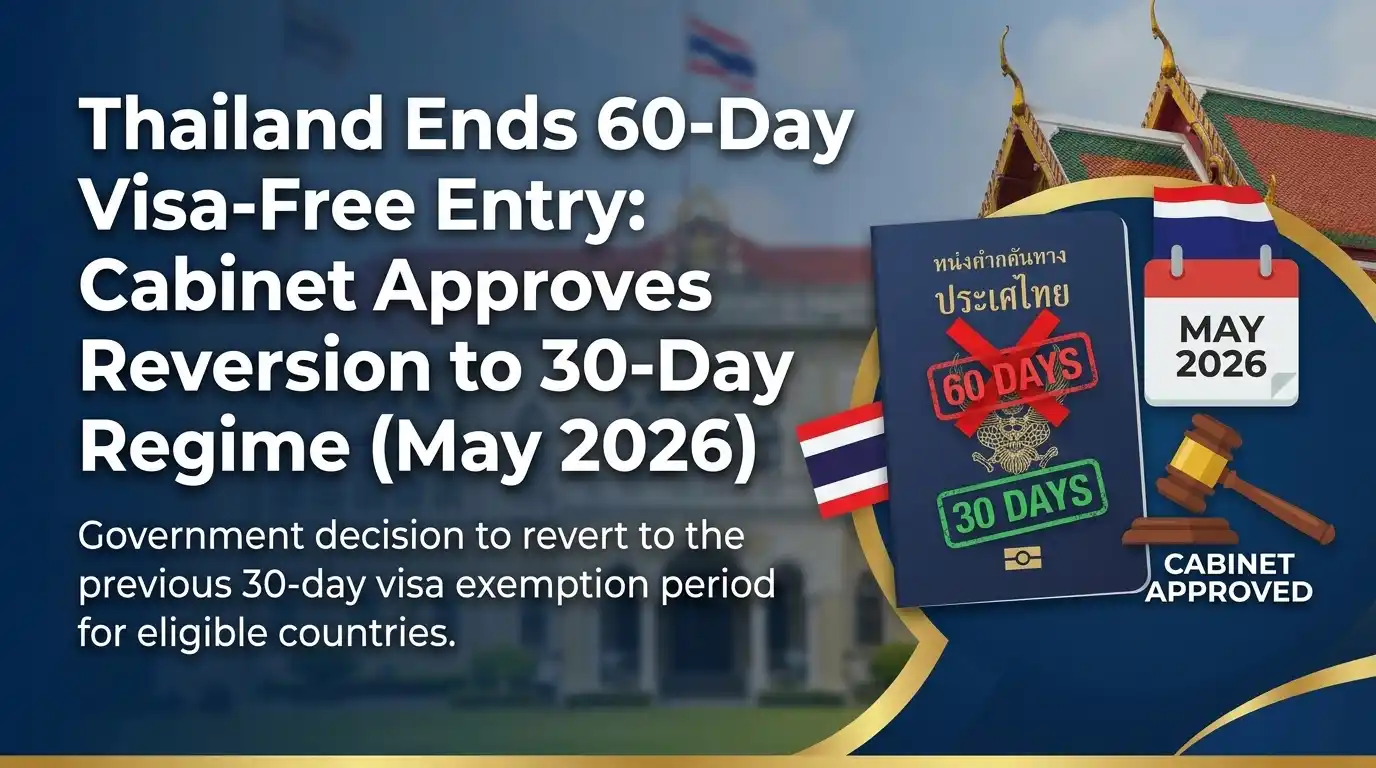
On 19 May 2026, the Thai Cabinet approved scrapping the 60-day visa-free entry scheme for 93 countries including the United Arab Emirates, reverting most nationalities to the pre-July-2024 30-day regime. The change takes effect 15 days after Royal Gazette publication. Current trips and already-issued visas are unaffected. OraVisa explains what UAE residents need to know.
Position Zero — What UAE Residents Need to Know
Key facts at a glance
- Cabinet decision date: 19 May 2026 — Thai Cabinet officially approved scrapping the 60-day visa-free entry scheme at a routine Cabinet meeting.
- Scope: 93 countries and territories including the UAE, India, Pakistan, Philippines, Bangladesh, Sri Lanka, Egypt, Jordan, UK, US, Canada, and Australia.
- Reversion: most nationalities return to the pre-15-July-2024 30-day visa-free regime; the 60-day window introduced under former PM Srettha Thavisin is scrapped.
- Effective date: 15 days after Royal Gazette publication. The Royal Gazette publication date has not been announced as of 20 May 2026.
- Current trips and already-issued visas are NOT affected — only entries made after the effective date are subject to the new 30-day limit.
- Local extension still available: visitors may extend for an additional 30 days at any Thai immigration office for THB 1,900 (unchanged from prior policy).
- Thailand Digital Arrival Card (TDAC): a separate mandatory pre-arrival document for ALL visitors — does NOT replace the visa-free regime; it is an additional layer.
What Has Changed
On 19 May 2026, at a routine Cabinet meeting, the Government of Thailand formally approved the proposal to scrap the 60-day visa-free entry scheme that has been in place since 15 July 2024 and to revert eligible nationalities to the prior 30-day regime. The decision affects 93 countries and territories, including the United Arab Emirates and the principal nationalities resident in the UAE. According to the official announcement reported by Nation Thailand, three Ministry of Interior notifications will be issued to give the decision legal effect, and the new rules will take effect 15 days after their publication in the Royal Gazette.
The Tourism Minister and the Ministry of Interior cited security concerns as the basis for the reversion — specifically, the assessment that the 60-day window had been exploited by foreign nationals working illegally, by criminal networks operating in tourist areas, and by individuals using the extended stay to circumvent the proper visa application route. The 30-day extension provision at local immigration offices (THB 1,900 fee, unchanged) remains available for visitors who require a longer stay.
From Ministerial Proposal to Cabinet Approval — Timeline
The Cabinet decision of 19 May 2026 concludes a two-month regulatory process that began with a Foreign Ministry proposal in March 2026. The sequence of regulatory stages is as follows:
- 122 March 2026 — Thai Ministry of Foreign Affairs gives the proposal a formal green light at a high-level meeting (ministerial stage).
- 219 May 2026 — Thai Cabinet officially approves the scrapping of the 60-day visa-free scheme at a routine Cabinet meeting (Cabinet stage).
- 3Pending as of 20 May 2026 — Ministry of Interior notifications drafted and submitted for Royal Gazette publication; four announcements, citing a further Cabinet approval of 14 July 2026, were published in the Royal Gazette on 31 August 2026.
- 415 days after Royal Gazette publication — New 30-day visa-free regime takes legal effect; entries made on or after that date are subject to the 30-day limit.
Affected Nationalities — Cohort View
Visa-free allowance — before and after the reversion
| Nationality cohort | Prior allowance (60-day regime) | New allowance (post-reversion) | Local extension available |
|---|---|---|---|
| UAE (Emirati) passport holders | 60 days visa-free | 30 days visa-free | Yes — additional 30 days at THB 1,900 |
| UK / US / Canada / Australia passport holders | 60 days visa-free | 30 days visa-free | Yes — additional 30 days at THB 1,900 |
| Saudi / Kuwaiti / Qatari / Bahraini / Omani GCC passport holders | 60 days visa-free | 30 days visa-free | Yes — additional 30 days at THB 1,900 |
| Indian / Filipino | 60 days visa-free | 30 days visa-free (both are in the approved 30-day tier) | Yes — additional 30 days at THB 1,900 |
| EU / Schengen passport holders | 60 days visa-free | 30 days visa-free | Yes — additional 30 days at THB 1,900 |
UAE (Emirati) passport holders
- Prior allowance (60-day regime)
- 60 days visa-free
- New allowance (post-reversion)
- 30 days visa-free
- Local extension available
- Yes — additional 30 days at THB 1,900
UK / US / Canada / Australia passport holders
- Prior allowance (60-day regime)
- 60 days visa-free
- New allowance (post-reversion)
- 30 days visa-free
- Local extension available
- Yes — additional 30 days at THB 1,900
Saudi / Kuwaiti / Qatari / Bahraini / Omani GCC passport holders
- Prior allowance (60-day regime)
- 60 days visa-free
- New allowance (post-reversion)
- 30 days visa-free
- Local extension available
- Yes — additional 30 days at THB 1,900
Indian / Filipino
- Prior allowance (60-day regime)
- 60 days visa-free
- New allowance (post-reversion)
- 30 days visa-free (both are in the approved 30-day tier)
- Local extension available
- Yes — additional 30 days at THB 1,900
EU / Schengen passport holders
- Prior allowance (60-day regime)
- 60 days visa-free
- New allowance (post-reversion)
- 30 days visa-free
- Local extension available
- Yes — additional 30 days at THB 1,900
The reversion applies uniformly across the 93 affected countries and territories — there is no differentiated treatment. Nationalities outside the visa-free list (which includes most South Asian, South-East Asian, and African passports commonly held by UAE residents) are unaffected by this specific change; their existing visa or visa-on-arrival requirements continue as before.
What This Means for UAE Residents
UAE residents fall into several distinct cohorts depending on passport and travel timing. The decision-relevant questions are: which passport do you hold, and is your trip booked before or after the Royal Gazette effective date.
UAE-resident impact by cohort
| Cohort | Already-booked trip (before effective date) | Future trip (after effective date) | Recommended action |
|---|---|---|---|
| Emirati passport holder | 60-day visa-free entry applies if you enter Thailand on or before 14 September 2026 | 30-day visa-free entry; extend in-country for additional 30 days if needed | Monitor Royal Gazette publication date; budget THB 1,900 for extension if staying longer than 30 days |
| Indian / Filipino passport holder resident in UAE | 60-day visa-free entry applies if you enter Thailand on or before 14 September 2026 | 30-day visa-free entry; in-country extension available for additional 30 days | Plan trip length around the 30-day allowance or budget for extension |
| British / American / Canadian / Australian passport holder resident in UAE | 60-day visa-free entry applies if you enter Thailand on or before 14 September 2026 | 30-day visa-free entry; in-country extension available for additional 30 days | Plan trip length around the 30-day allowance or budget for extension |
| UAE resident on Emirati / Western passport already in Thailand on a 60-day entry | Stay is unaffected — your entry was made under the 60-day regime and remains valid | N/A — applies to current trip only | No action needed for the current trip |
| UAE resident planning stay longer than 30 days (Emirati / Western passport) | 60 days available if you enter Thailand on or before 14 September 2026 | 30 days + 30-day extension (THB 1,900) OR apply for a 60-day Tourist Visa in advance | For predictability, consider applying for a 60-day Tourist Visa via OraVisa rather than relying on in-country extension |
Emirati passport holder
- Already-booked trip (before effective date)
- 60-day visa-free entry applies if you enter Thailand on or before 14 September 2026
- Future trip (after effective date)
- 30-day visa-free entry; extend in-country for additional 30 days if needed
- Recommended action
- Monitor Royal Gazette publication date; budget THB 1,900 for extension if staying longer than 30 days
Indian / Filipino passport holder resident in UAE
- Already-booked trip (before effective date)
- 60-day visa-free entry applies if you enter Thailand on or before 14 September 2026
- Future trip (after effective date)
- 30-day visa-free entry; in-country extension available for additional 30 days
- Recommended action
- Plan trip length around the 30-day allowance or budget for extension
British / American / Canadian / Australian passport holder resident in UAE
- Already-booked trip (before effective date)
- 60-day visa-free entry applies if you enter Thailand on or before 14 September 2026
- Future trip (after effective date)
- 30-day visa-free entry; in-country extension available for additional 30 days
- Recommended action
- Plan trip length around the 30-day allowance or budget for extension
UAE resident on Emirati / Western passport already in Thailand on a 60-day entry
- Already-booked trip (before effective date)
- Stay is unaffected — your entry was made under the 60-day regime and remains valid
- Future trip (after effective date)
- N/A — applies to current trip only
- Recommended action
- No action needed for the current trip
UAE resident planning stay longer than 30 days (Emirati / Western passport)
- Already-booked trip (before effective date)
- 60 days available if you enter Thailand on or before 14 September 2026
- Future trip (after effective date)
- 30 days + 30-day extension (THB 1,900) OR apply for a 60-day Tourist Visa in advance
- Recommended action
- For predictability, consider applying for a 60-day Tourist Visa via OraVisa rather than relying on in-country extension
Thailand Digital Arrival Card (TDAC) — Separate Requirement
Separate from the visa-free reversion, the Thailand Digital Arrival Card (TDAC) is a mandatory pre-arrival document that ALL visitors to Thailand must complete online before their flight. The TDAC replaces the previously discussed eTA proposal and serves as the digital equivalent of the old paper TM6 arrival card. It is a digital arrival declaration — it does NOT replace the visa-free regime, and it does NOT grant entry by itself. UAE residents travelling to Thailand on or after the Royal Gazette effective date must therefore satisfy both requirements: (1) the new 30-day visa-free entry rule for eligible nationalities (or the relevant visa/VOA for non-eligible nationalities), and (2) the TDAC completed pre-arrival.
What You Should Do Now
- 1Note the dates — the announcements were published in the Royal Gazette on 31 August 2026 and the new 30-day rule applies to entries from 15 September 2026; check the entry route for your passport on the Thailand eVisa Official Portal at thaievisa.go.th before booking longer trips.
- 2Check that the 30-day stay covers your planned trip — if you are an Emirati or Western passport holder and your stay is 30 days or less, no action is needed beyond completing the TDAC.
- 3Consider the 30-day in-country extension if your stay will exceed 30 days — extensions are available at any Thai immigration office for THB 1,900 (unchanged); this brings the maximum stay to 60 days.
- 4Complete the Thailand Digital Arrival Card (TDAC) pre-arrival — this is mandatory for ALL visitors regardless of nationality, visa-free or visa-required.
- 5Verify your specific visa route on the official Thailand eVisa portal at thaievisa.go.th before travel — confirm whether your passport is on the visa-free list or requires a Tourist Visa / VOA.
- 6If the 30-day visa-free allowance plus extension is insufficient for your planned trip, consult OraVisa about applying for a 60-day Tourist Visa in advance — a predictable, embassy-issued route that does not depend on in-country immigration office discretion.
Planning a Thailand trip longer than 30 days from Dubai?
If you hold an Emirati or Western passport and your planned Thailand stay exceeds 30 days, the most predictable route after the Royal Gazette effective date is a 60-day Tourist Visa applied in advance. OraVisa can help you choose between the visa-free + extension route and the Tourist Visa route based on your travel dates, document situation, and the published Royal Gazette effective date — and prepare the full application if a visa is the right option.
Get Free Visa AssessmentDisclaimer
This update is based on publicly available information from the Thailand eVisa Official Portal (thaievisa.go.th) and credible international news reporting as of 20 May 2026. At that date the Cabinet decision of 19 May 2026 had been formally approved but was not yet legally in effect — Ministry of Interior notifications still had to be published in the Royal Gazette, with the new 30-day regime to take effect 15 days after that publication, and no publication date had been announced. Four Ministry of Interior announcements, citing a further Cabinet approval of 14 July 2026, were later published in the Royal Gazette on 31 August 2026, with effect from 15 September 2026. Thai authorities have stated that travellers who entered Thailand under a visa exemption before 15 September 2026 may stay until the last date of their permitted period of stay shown on their immigration stamp. Current trips and already-issued Thai visas are not affected. This analysis is provided for informational purposes to help UAE residents understand the policy change. It does not constitute legal advice. For the latest official information, always refer to the Thailand eVisa Official Portal at https://thaievisa.go.th/.
Sources
- Thailand eVisa Official Portal — Government of Thailand— Verified 2026-05-20
- Nation Thailand — "Thailand scraps 60-day free visa, restores old exemption rules"— Verified 2026-05-20
- Nation Thailand — "Thailand to scrap 60-day visa waiver over criminals posing as tourists"— Verified 2026-05-19
- Al Jazeera — "Thailand to slash tourist visa-free stays"— Verified 2026-05-19
- Khaosod English — "What to know about Thailand ending 60-day visa-free stays"— Verified 2026-05-19
Verified Official Sources
- Thailand eVisa Official Portal — Government of Thailand — Official Thai government portal for visa applications and entry-requirement guidance for all nationalities [Visit Source](Verified: 20 May 2026)
- Nation Thailand — "Thailand scraps 60-day free visa, restores old exemption rules" — Cabinet decision of 19 May 2026 to scrap the 60-day visa-free scheme and revert to the prior 30-day regime; three Ministry of Interior notifications forthcoming; 15-day Royal Gazette implementation window [Visit Source](Verified: 20 May 2026)
- Nation Thailand — "Thailand to scrap 60-day visa waiver over criminals posing as tourists" — Security rationale cited by Tourism Minister and Ministry of Interior for reverting to the 30-day regime [Visit Source](Verified: 19 May 2026)
- Al Jazeera — "Thailand to slash tourist visa-free stays" — International coverage of the Thai Cabinet decision and 93-country scope [Visit Source](Verified: 19 May 2026)
- Khaosod English — "What to know about Thailand ending 60-day visa-free stays" — Practical guidance on the 30-day reversion, the in-country extension provision, and the Thailand Digital Arrival Card (TDAC) context [Visit Source](Verified: 19 May 2026)
Related Pages
Affected Countries
Nationality Guides
Related Guides
Relevant Services
Frequently Asked Questions
Will my already-booked Thailand trip in June 2026 be affected?
It depends on the Royal Gazette publication date. The new 30-day rule takes effect 15 days after the Royal Gazette publication. As of 20 May 2026, that publication date has not yet been announced. The effective date is 15 September 2026: if your passport is on the 60-day list and your entry to Thailand is on or before 14 September 2026, the 60-day visa-free entry applies to that entry. If your entry is on or after the effective date, you will be subject to the new 30-day limit (with an optional 30-day in-country extension at THB 1,900). Check the Thailand eVisa Official Portal at thaievisa.go.th before you travel.
I'm a UAE resident on an Indian, Pakistani, or Filipino passport — does this affect me?
It depends on your nationality. Indian and Filipino passport holders ARE on the Thai visa-free list and are affected: both are in the approved 30-day tier, so they remain visa-exempt and their permitted stay shortens from 60 days to 30 once the change takes effect — neither moves to a visa on arrival. Pakistani, Bangladeshi, Sri Lankan, Egyptian and Jordanian passport holders are not on the visa-free list, so their route is unchanged: apply for an eVisa via the official Thailand eVisa portal at thaievisa.go.th. OraVisa can assist with the eVisa application.
Can I still get 60 days in Thailand somehow?
Yes — there are two routes. First, the 30-day visa-free entry plus a 30-day in-country extension at any Thai immigration office (THB 1,900 fee) brings your total stay to 60 days. Second, you can apply in advance for a 60-day Tourist Visa (TR) at the Royal Thai Embassy in the UAE or via the official Thai eVisa portal — this is the standard procedural route and gives you a 60-day stay without relying on the in-country extension process. The Tourist Visa route is more predictable for trips you know will exceed 30 days.
What is the Thailand Digital Arrival Card (TDAC)?
The Thailand Digital Arrival Card (TDAC) is a mandatory pre-arrival document that ALL visitors to Thailand must complete online before their flight, regardless of nationality or visa status. It replaces the previously discussed eTA proposal and is the digital equivalent of the old paper TM6 arrival card. The TDAC is separate from the visa-free regime — it does not grant entry by itself, and it does not replace the new 30-day rule. UAE residents travelling to Thailand must therefore complete the TDAC pre-arrival in addition to satisfying the relevant visa-free or visa requirement.
When exactly will the 30-day rule take effect?
The new 30-day rule applies to entries from 15 September 2026: four Ministry of Interior announcements were published in the Thai Royal Gazette on 31 August 2026 and come into force fifteen days after publication, and the Thai authorities have published 15 September 2026 as the effective date. As of 20 May 2026, when this record was written, no publication date had been announced. The Cabinet approvals of 19 May and 14 July 2026 were the political decisions; the Royal Gazette publication was the legal trigger. Check the entry route for your passport on the Thailand eVisa Official Portal at thaievisa.go.th before booking longer trips.
Can I extend my 30-day stay locally in Thailand?
Yes. Under the reverted regime, visitors who entered visa-free for 30 days may apply for a single 30-day extension at any Thai immigration office. The fee is THB 1,900 (unchanged from prior policy). The extension brings the maximum total stay to 60 days. Required documents typically include passport, TM.30 address registration, a recent photograph, and the fee. The extension is granted at the discretion of the immigration office; applicants should apply before the initial 30-day stay expires.
Where can I verify the current Thailand visa policy?
The authoritative source is the Thailand eVisa Official Portal at https://thaievisa.go.th/. The portal lists current visa-free eligible nationalities, eVisa application procedures, and effective dates of policy changes. For UAE residents, the Royal Thai Embassy in Abu Dhabi and the Royal Thai Consulate-General in Dubai are also authoritative for visa applications and direct enquiries. OraVisa can guide you through visa application procedures from Dubai if a visa is required for your planned trip.
Need Help Understanding This Change?
OraVisa stays on top of every visa policy change so you don't have to. Get a free consultation about how this affects your travel plans.
Get Free ConsultationWritten by
Priya Sharma
Senior Visa Consultant — Asia & Americas
Senior Visa Consultant specializing in Asian & American destinations. 8 years of experience with a proven track record in complex multi-country applications.
Last verified: